jingzhang
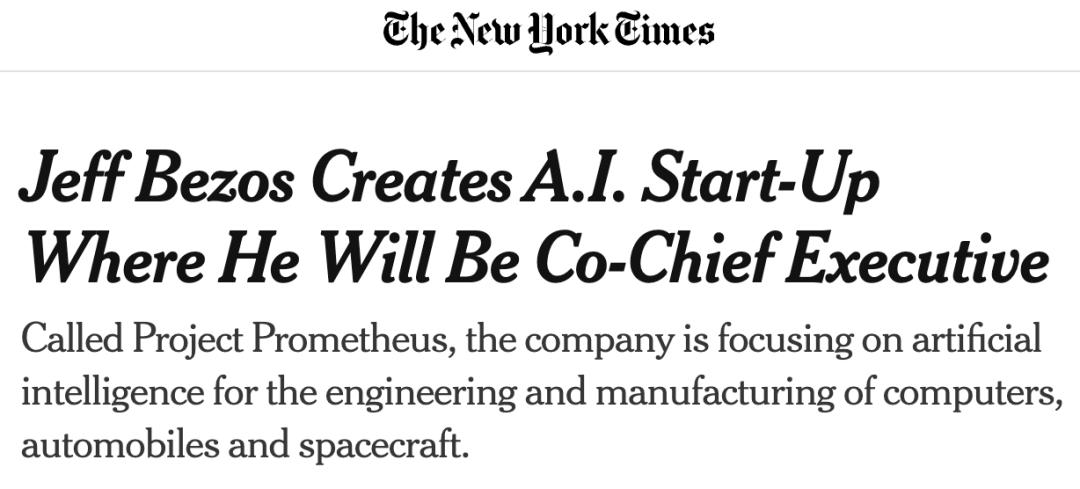
According to The New York Times, the former world’s richest man has founded a new company and serves as its co-CEO. With substantial financial backing, including an investment from Bezos himself, the company has secured $6.2 billion in funding.
This marks the first time Bezos has assumed a formal operational role since stepping down as CEO of Amazon.
Bezos Dives into Physical AI
Last year, Bezos invested in Physical Intelligence, a top AI robotics company founded by embodied AI expert Sergey Levine. Now, he has personally stepped in to establish Project Prometheus, venturing into the field of physical AI. With Bezos’s involvement, the newly founded company has a strong financial foundation, having raised $6.2 billion, equivalent to approximately 44 billion yuan.
It already boasts a workforce of over a hundred employees, including researchers poached from top AI companies such as OpenAI and DeepMind. Project Prometheus’s research projects involve applying artificial intelligence to physical tasks like robotics, drug design, and scientific discovery, with a clear focus on high-tech sectors such as computing, automotive, and aerospace.
The company’s technological focus aligns with Bezos’s interest in sending humans into outer space, as he has previously been deeply involved in Blue Origin, a rival to Elon Musk’s SpaceX. In terms of technological direction, Project Prometheus aims to develop AI models that learn in more complex ways than existing mainstream chatbots like ChatGPT, enabling them to learn from the physical world.
Bezos’s co-founder and fellow co-CEO for this venture is Vik Bajaj, a physicist and chemist who is also an adjunct professor at Stanford School of Medicine.
Separate market sentiment from product execution
Price movement and social attention can react instantly, while technology deployment takes longer. A useful analysis asks what operational milestone would prove that the story has changed real behavior. That milestone might be production use, a measurable cost change, a regulatory approval or sustained customer demand rather than one day of market volatility.
Identify the assumptions behind the forecast
Every long-term scenario depends on assumptions about adoption, competition, capacity and policy. Making those assumptions explicit helps readers understand what evidence would cause the outlook to improve or weaken.
How to interpret the development beyond the headline
Fast-moving technology and crypto stories should separate confirmed facts from forecasts, market reaction and interpretation. Product launch, adoption, liquidity, regulation and execution can all determine whether an early headline becomes a durable shift. The useful follow-up is concrete evidence: shipped capability, user growth, audited transactions, financial guidance or regulatory decisions that confirm or weaken the initial narrative.
Watch second-order effects
Major developments can change incentives for developers, creators, exchanges, infrastructure providers and users. The practical impact may appear through costs, standards, distribution or policy rather than through the headline event itself. Keeping long-term scenarios conditional makes later updates easier to interpret without rewriting early speculation as fact.
Practical implementation check
Before adopting the mechanism described above, define the exact business rule, who controls it and what evidence will show that it worked. Test the failure path as carefully as the successful path, especially when rights, payments or wallet actions are involved. The final system should also document versioning, rollback and the assumptions that may become stale over time. That turns a one-off experiment into an operating model that creators, users and developers can understand.


 admin