jingzhang
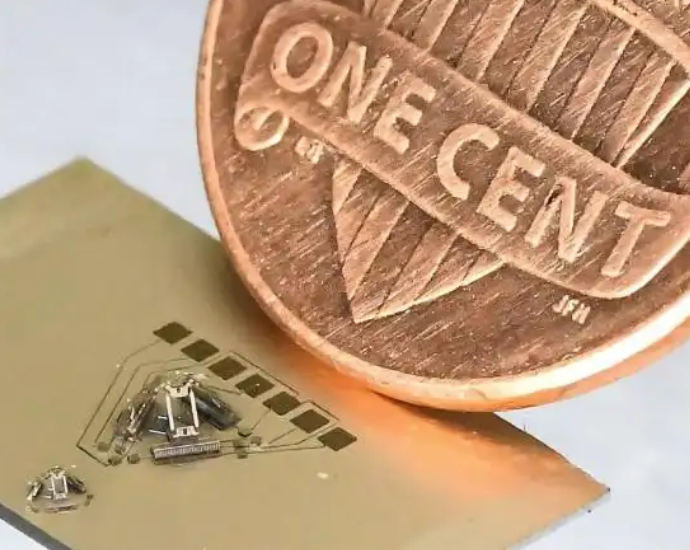
Scientists from Carnegie Mellon University in the United States have developed a novel 3D printing process and successfully manufactured micro delta robots named microDeltas. These robots are expected to play significant roles in fields such as micromanipulation, microassembly, minimally invasive surgery, and wearable haptic devices. The relevant research paper has been published in the latest issue of the journal Science Robotics.
Delta robots, also known as parallel robots or parallelogram robots, are high-speed, light-load parallel robots. Their robotic arms are composed of three parallel support rods and adopt a parallelogram structure. They are widely applied in areas including food packaging, pharmaceutical sorting, electronic assembly, and new energy vehicle die-casting processing.
As early as the advent of microelectromechanical systems (MEMS) in the 1980s, engineers envisioned using them to manufacture micro robots. The laws of physical scaling also suggest that miniaturized robots have the potential to achieve breakthroughs in terms of speed and precision. However, limited by the micro 3D manufacturing technologies of the time, scaling robots down to microscopic sizes was no easy feat.
This time, the team developed a 3D printing process based on two-photon polymerization. This is an advanced nanofabrication technology that precisely cures photosensitive materials by focusing laser beams. After that, a thin layer of metal is deposited to create complex 3D structures and actuators with electrical functionality, eliminating the need for manual folding or assembly.
Using this technology, the team manufactured micro delta robots with heights of only 1.4 millimeters and 0.7 millimeters. Compared with similar robots, they are the smallest and fastest to date. Experiments have confirmed that reducing the size not only enhances the robots’ precision to the sub-micron level but also enables them to operate at frequencies exceeding 1 kilohertz. They can even launch salt particles equivalent to 7.4% of their own mass.
The team stated that with the aid of 3D design and printing technologies, they completed eight design iterations of the robots in a very short time, whereas traditional methods might have taken weeks or even months. In the future, by adjusting design parameters, constructing large-scale arrays, or introducing sensory feedback, the bandwidth, precision, and working range of the robots can be further improved.
Separate market sentiment from product execution
Price movement and social attention can react instantly, while technology deployment takes longer. A useful analysis asks what operational milestone would prove that the story has changed real behavior.
That milestone might be production use, a measurable cost change, a regulatory approval or sustained customer demand rather than one day of market volatility.
Identify the assumptions behind the forecast
Every long-term scenario depends on assumptions about adoption, competition, capacity and policy. Making those assumptions explicit helps readers understand what evidence would cause the outlook to improve or weaken.
How to interpret the development beyond the headline
Fast-moving technology and crypto stories should separate confirmed facts from forecasts, market reaction and interpretation. Product launch, adoption, liquidity, regulation and execution can all determine whether an early headline becomes a durable shift.
The useful follow-up is concrete evidence: shipped capability, user growth, audited transactions, financial guidance or regulatory decisions that confirm or weaken the initial narrative.
Watch second-order effects
Major developments can change incentives for developers, creators, exchanges, infrastructure providers and users. The practical impact may appear through costs, standards, distribution or policy rather than through the headline event itself.
Keeping long-term scenarios conditional makes later updates easier to interpret without rewriting early speculation as fact.
Practical implementation check
Before adopting the mechanism described above, define the exact business rule, who controls it and what evidence will show that it worked. Test the failure path as carefully as the successful path, especially when rights, payments or wallet actions are involved.
The final system should also document versioning, rollback and the assumptions that may become stale over time. That turns a one-off experiment into an operating model that creators, users and developers can understand.


 admin