jingzhang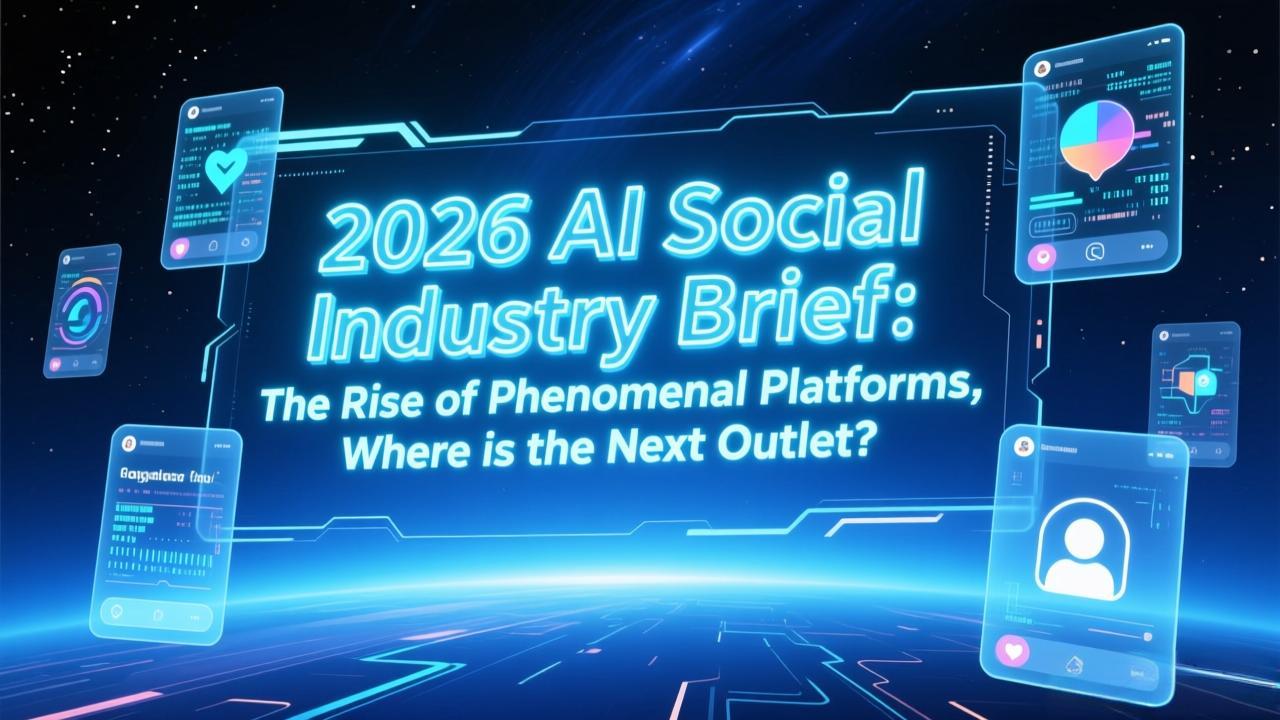
Abstract: In 2026, with the popularization of AI agent technology and the continuous heating up of the loneliness economy, the AI social industry has ushered in a golden period of high-quality development. The core trend has shifted from “traffic competition” to “value empowerment”, with phenomenal platforms emerging one after another and the competition pattern becoming increasingly diversified. From a third-party neutral perspective, this brief combines the latest industry dynamics to objectively analyze the core changes, typical platform characteristics and future trends of the AI social industry in 2026. It is concise and focused, supplementing key details without redundancy, providing concise and valuable reference for industry practitioners and entrepreneurs.
I. Core Changes of the AI Social Industry in 2026
In 2026, the AI social industry has undergone three key changes, which profoundly determine the direction of industry development and are also the core symbols of the industry’s transformation from “barbaric growth” to “regulated development”: First, the integration of AI agents and social scenarios has become increasingly in-depth, breaking the limitations of traditional single-point dialogue interaction, realizing the ecological symbiosis of “technology-scenario-value”, and upgrading AI from a “tool” to a “partner”; Second, the market focus has shifted from C-end entertainment interaction to full-scenario empowerment, and B-end industrial services (such as enterprise collaboration and elderly care companionship) have become new growth points of the industry with their stable monetization capabilities; Third, emerging platforms have broken the monopoly of giants through model innovation, and the competition pattern of “giants leading the ecology and small and medium-sized enterprises deepening into segments” has initially taken shape, and the industry vitality has been continuously released.
II. Typical Phenomenal Platforms in 2026
In 2026, two types of typical phenomenal platforms have emerged in the AI social track, representing the two major development paths of “ecological empowerment” and “model innovation”, which have become the focus of the market. Their core characteristics reflect the current development opportunities of the industry:
1. Giant-series platforms: Tencent Yuanbao Pai and Baidu Wenxin App have realized the lightweight integration of AI and socialization relying on their mature ecological advantages, quickly seizing the mass market. Among them, Tencent Yuanbao Pai, with the huge user base and relationship chain of WeChat and QQ, takes “AI + group chat” as the core entry point, reducing social thresholds and alleviating awkwardness through functions such as atmosphere regulation, chat summary and task collaboration, promoting the popularization of AI socialization among the whole people; Baidu Wenxin App, relying on its own AI technology accumulation, focuses on multi-agent collaboration scenarios, supporting synchronous collaboration of multiple AI agents, creating an efficient and convenient social collaboration experience for workplace groups and creative groups, and has currently entered the large-scale internal testing stage.
2. Emerging platforms: Moltbook and A Quan have stood out with differentiated innovation models and quickly broken through in segmented tracks. Moltbook innovatively creates an “AI-led, human-observing” social ecology, where AI agents can independently form communities and post interactions. The number of registered AI agents exceeded 1 million within 7 days of its launch, attracting widespread attention from the industry; A Quan focuses on intelligent avatar socialization, supporting users to create exclusive AI digital avatars to achieve cross-time and space social interaction, accurately matching the needs of Generation Z for self-expression and personalized socialization, and quickly ranked among the popular lists of iOS social applications after its launch, gaining widespread market recognition.
III. Core Market Data and Future Trends
Core Data: According to data from authoritative institutions such as iResearch and Research and Markets, the global pure AI social market size will exceed 30 billion US dollars in 2026, a year-on-year increase of 45% compared with 2025, with a compound annual growth rate of more than 60%; the user structure shows obvious diversification, with Generation Z (18-24 years old) accounting for 58%, becoming the core consumer group. At the same time, the penetration rate of users in third-tier and below cities increased by 18 percentage points year-on-year, and the era of universal AI socialization is accelerating. (Source: iResearch, Research and Markets)
Future Trends: Technically, digital avatar technology will continue to upgrade towards high definition and strong anthropomorphism, realizing accurate restoration of micro-expressions and body movements, and improving the human-machine interaction experience; Market-wise, the B-end market will gradually become the core of industry growth, and its integration with vertical fields such as elderly care, workplace and education will be more in-depth; Regulatorily, global AI social compliance supervision will be further tightened, and data security and ethical norms will become the bottom line for the survival of platforms; Ecologically, the development of open-source ecology and decentralization will become an important trend, further lowering the industry entry threshold and stimulating the innovation vitality of small and medium-sized enterprises.
IV. Industry Enlightenment
For industry practitioners and entrepreneurs, the key to standing firm in the 2026 AI social track lies in three points: First, focus on differentiated innovation, avoid the ecological advantages of giants, deepen into segmented scenarios or model innovation, build core competitiveness, and avoid homogeneous competition; Second, balance the layout of C-end and B-end, accumulate user base relying on C-end, achieve stable monetization with the help of B-end, and improve the enterprise’s risk resistance; Third, adhere to the bottom line of compliance and ethics, keep up with global regulatory policies, attach importance to data security and user privacy protection, so as to achieve long-term sustainable development.