jingzhang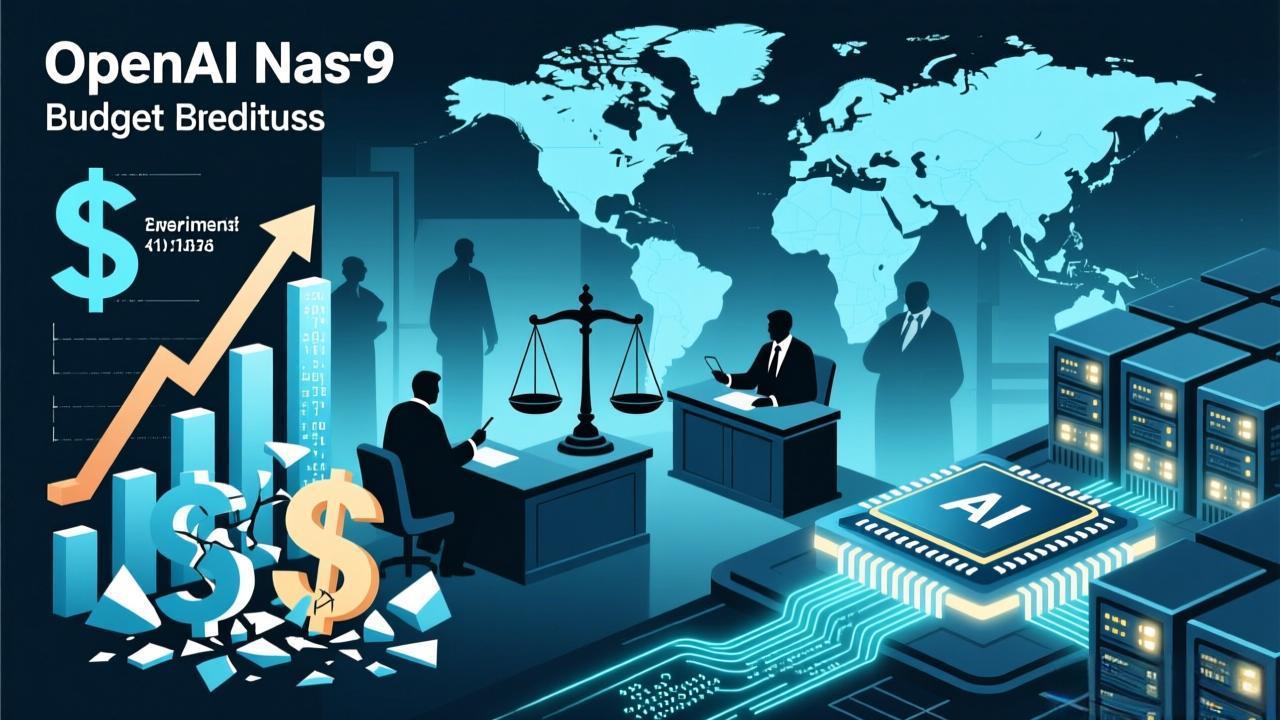
【Comprehensive Report by Global Network, Pengpai News and Securities Times】In late February 2026, OpenAI, the global leader in generative AI, made a series of major strategic adjustments that sent shockwaves through the industry. From slashing its trillion-dollar computing power investment plan by nearly 57% to facing consecutive legal lawsuits, and from restructuring cooperation with NVIDIA to accelerating its foray into the hardware sector, the company’s recent moves have not only revealed its internal operational pressures but also signaled a critical shift in the global AI industry from “rampant expansion” to “rational development”. These developments, closely tracked by authoritative media such as CNBC, The Information and Korea Herald, have become another focus of the international AI industry following Anthropic’s dual shocks.
Sharp Cut in Computing Power Budget: From $1.4 Trillion to $600 Billion, a Forced Retreat from Blind Expansion
On February 21, 2026, authoritative overseas media including CNBC and The Information broke the news that OpenAI had officially adjusted its long-term computing power infrastructure investment target, slashing it from the previously announced $1.4 trillion to $600 billion, a reduction of nearly 57% or $800 billion. This drastic adjustment, rare in the history of global technology industry development, marks a clear shift in OpenAI’s strategy from “unbridled expansion” to “prudent development”.
According to insiders, the core reason for the budget cut lies in the imbalance between the company’s revenue growth and capital consumption. OpenAI’s latest disclosed 2025 operating data shows that the company achieved a total annual revenue of $13.1 billion, exceeding the original target of $10 billion, and its actual capital consumption was $8 billion, slightly lower than the planned $9 billion. However, the adjusted gross profit margin was only 33%, far lower than the 70%+ level of mature software companies and the 50%-65% range of cloud service providers, indicating extremely low profitability efficiency. More importantly, OpenAI internally predicts that it will not achieve positive cash flow until 2030, meaning it will continue to “burn money” for the next four years and cannot achieve self-sufficiency through its own business.
OpenAI has explicitly stated to its investors that the new $600 billion investment plan will be strictly linked to expected revenue growth, focusing on more efficient and return-generating areas instead of blind scale expansion and computing power stacking. This move is widely regarded as a landmark signal that the global AI industry’s “race to burn money and compete for computing power” has officially ended.
Dual Legal Challenges: Lawsuits Dismissed but Copyright Disputes Persist
While adjusting its computing power strategy, OpenAI is also embroiled in two high-profile legal battles. On February 24, local time, U.S. District Judge Rita Lin of the Northern District of California officially dismissed a trade secret theft lawsuit filed by Elon Musk’s xAI against OpenAI and its CEO Sam Altman, ruling that the existing allegations failed to prove that OpenAI engaged in improper conduct.
The lawsuit, filed by xAI in September 2025, claimed that several former employees illegally took source code and technical secrets related to xAI’s chatbot Grok when they jumped to OpenAI, and that OpenAI indirectly obtained its core competitive technology by hiring these employees, constituting unfair competition. However, Judge Rita Lin pointed out in her ruling that xAI’s complaint “failed to allege any conduct by OpenAI itself that induced or participated in the theft of trade secrets” and provided no evidence that “the former employees actually used the stolen technology during their employment at OpenAI”. She emphasized that “the law requires the plaintiff to prove that the defendant directly participated in improper conduct, not just the individual actions of related parties”. OpenAI welcomed the ruling, calling the lawsuit “groundless” and “another pretext for Mr. Musk’s continued harassment”. xAI has not yet commented on the dismissal, but it still has until March 17 to revise and refile its complaint.
On the same day, three major South Korean broadcasters—KBS, MBC, and SBS—officially sued OpenAI, accusing the company of using their news content to train its generative AI model ChatGPT without authorization, and demanding a court injunction to stop the infringement and claim damages. The Korea Broadcasters Association (KBA) emphasized that the news content is the core asset of the three broadcasters, but OpenAI has refused to negotiate with major South Korean broadcasters and continues to implement discriminatory copyright policies. It is worth noting that this is not the first time South Korean mainstream media have challenged AI training data; in January 2025, the three broadcasters also sued Naver for similar reasons, but later reached a cooperation with Naver in July of the same year.
Financing and Cooperation Restructuring: $100 Billion Financing Imminent, NVIDIA Partnership Shaken
Amid budget cuts and legal disputes, OpenAI’s massive financing plan has made new progress. The company is finalizing a financing round of more than $100 billion, which will push its overall valuation to over $850 billion after completion. Approximately 90% of the funds will come from strategic investors including NVIDIA, SoftBank Group, and Amazon, and will be mainly used for computing power hardware procurement, data center construction, and AI infrastructure improvement.
A major change in the cooperation pattern has also emerged: the $100 billion multi-year cooperation framework previously announced by OpenAI and NVIDIA has been officially terminated and replaced by a direct investment of nearly $300 billion from NVIDIA. In September 2025, the two companies announced an “intent letter” stating that NVIDIA would invest $10 billion in 10 installments to acquire important equity, while OpenAI would purchase millions of NVIDIA AI chips to support the deployment of 10 gigawatts of new computing power. However, the agreement, which once pushed NVIDIA’s market value above $5 trillion, remained only a memorandum and never officially took effect, and was finally shelved in January 2026 before being replaced by the new direct investment plan. Industry analysts believe that this change reflects NVIDIA’s growing caution about OpenAI’s blind expansion strategy.
In addition, OpenAI has also established in-depth cooperation with chip manufacturers AMD, Broadcom, and cloud service provider Oracle, forming a complex “supplier-customer-investor” binding model. This model has aroused concerns among analysts, who warn of potential risks in the circular structure, accumulating industry bubbles, and excessive reliance on a single hardware manufacturer, which weakens risk resistance capacity.
Hardware Foray: $6.5 Billion Acquisition, First Smart Speaker to Launch in 2027
While contracting its computing power investment, OpenAI is accelerating its layout in the hardware sector to seek new growth drivers. The company has established a dedicated hardware team of more than 200 people and spent $6.5 billion to acquire io Products, a startup founded by former Apple top designer Jony Ive, marking its official entry into the physical AI and AR device market.
OpenAI’s hardware roadmap has been exposed: its first product will be an AI smart speaker priced between $200 and $300, scheduled to go on sale in February 2027, with a built-in camera capable of capturing user and environmental information. Subsequently, the company plans to launch smart glasses in 2028 and other home AI hardware such as smart lights. This move comes as Meta’s Ray-Ban smart glasses have gained a foothold in the market, and Apple and Google are also developing similar products, indicating that OpenAI is striving to seize the next wave of dividends in the “AI + physical terminal” field.
Industry insiders point out that OpenAI’s current strategy has been fully transformed: shifting from “rampant computing power construction” to “capacity-based development” in computing power, linking capital consumption to revenue, and transforming from “pure large model focus” to “model + hardware dual-drive” in business focus. This “shrinking in one area and expanding in another” strategy is an attempt by the AI giant to balance development speed and operational risks.
Industry Impact: OpenAI’s Shifts Accelerate Global AI Industry Transformation
OpenAI’s series of strategic adjustments have had a profound impact on the global AI industry pattern. First, it has eased the competitive pressure on competitors such as Anthropic and Google, as the industry’s “burn money race” has cooled down, allowing more enterprises to focus on technological innovation and profitability improvement rather than blind scale expansion. Second, it has triggered a chain reaction in the AI industry’s investment and financing market, with investors becoming more rational and paying more attention to the sustainability of enterprises’ cash flow and profitability, which will help squeeze industry bubbles and promote healthy development.
In addition, OpenAI’s legal disputes over copyright also highlight the increasingly prominent problem of AI training data compliance. As more media and content creators take legal action to protect their intellectual property rights, it is expected that global AI enterprises will face stricter copyright supervision, forcing the industry to establish a more standardized training data acquisition mechanism. At the same time, OpenAI’s entry into the hardware sector may reshape the industrial chain pattern of “software + hardware” integration in the AI field, triggering a new round of competition in the physical AI terminal market.
Outlook: Balancing Scale and Profitability, the Road Ahead Remains Uncertain
As of February 26, 2026, OpenAI’s $100 billion financing plan is still in the final negotiation stage, and the specific launch time of its first hardware product has not yet been officially confirmed. Industry analysts predict that OpenAI’s strategic shift will be a long-term process: on the one hand, it needs to strictly control capital consumption and improve profitability to achieve the 2030 cash flow positive target; on the other hand, it needs to cope with ongoing legal disputes and fierce market competition, while exploring the potential of the hardware sector to find new growth points.
It is worth noting that OpenAI’s adjustments are not an isolated case, but a microcosm of the global AI industry’s transition from “high-speed growth” to “high-quality development”. With the intensification of regulatory pressure and the return of capital rationality, more AI enterprises will follow suit to adjust their strategies, focusing on balancing technological iteration, commercial interests and compliance risks, which will help promote the global AI industry to enter a more mature and sustainable development stage.
News Source and Data Source Description
- Core news events (computing power budget cut, financing progress, hardware layout): CNBC, The Information (February 21, 2026), Securities Times (February 21, 2026) [5];
- xAI vs. OpenAI trade secret lawsuit: Global Network (February 25, 2026), Pengpai News (February 25, 2026) [1][3];
- South Korean broadcasters suing OpenAI: Global Network (February 24, 2026) [4];
- OpenAI 2025 operating data, gross profit margin, cash flow forecast: The Information (February 21, 2026) [2];
- NVIDIA cooperation adjustment, financing valuation: Securities Times (February 21, 2026) [5];
- Hardware layout, acquisition information: The Information, Securities Times (February 21, 2026) [2][5].