jingzhang
As the AI social track remains mired in the rat race of feature stacking, an app named Tuikor is breaking through in a different way. Unlike most similar products that focus on developing practical functions such as weather checks and schedule reminders, Tuikor centers on the overlooked dimension of “emotional connection,” quietly reshaping people’s perception of AI social interaction. In the overseas social market, its rise is not driven by intensive marketing campaigns but by user-initiated dissemination and word-of-mouth accumulation, making it a noteworthy phenomenal product in the AI social sector.
Looking back at the development of AI social interaction, it is not difficult to find that most products have never been able to break free from the shackles of “instrumentalization.” Early AI chatbots focused on information interaction to meet users’ basic inquiry needs; subsequent iterative products, although adding more interactive features, essentially remained at the level of “functional services,” lacking in-depth insight into users’ emotional needs. The communication between users and AI is more like a back-and-forth task-oriented dialogue rather than an equal emotional exchange, which also makes it difficult for most AI social apps to form long-term user stickiness.
The emergence of Tuikor precisely hits this industry pain point. It completely breaks free from the limitations of “tool thinking,” shifting the core of the product from “what it can do for users” to “how it can resonate emotionally with users.” This transformation is not a simple functional adjustment but a re-interpretation of the essence of AI social interaction— the core of social interaction has never been the superposition of functions, but the emotional flow between people, and the same should apply to AI social interaction.
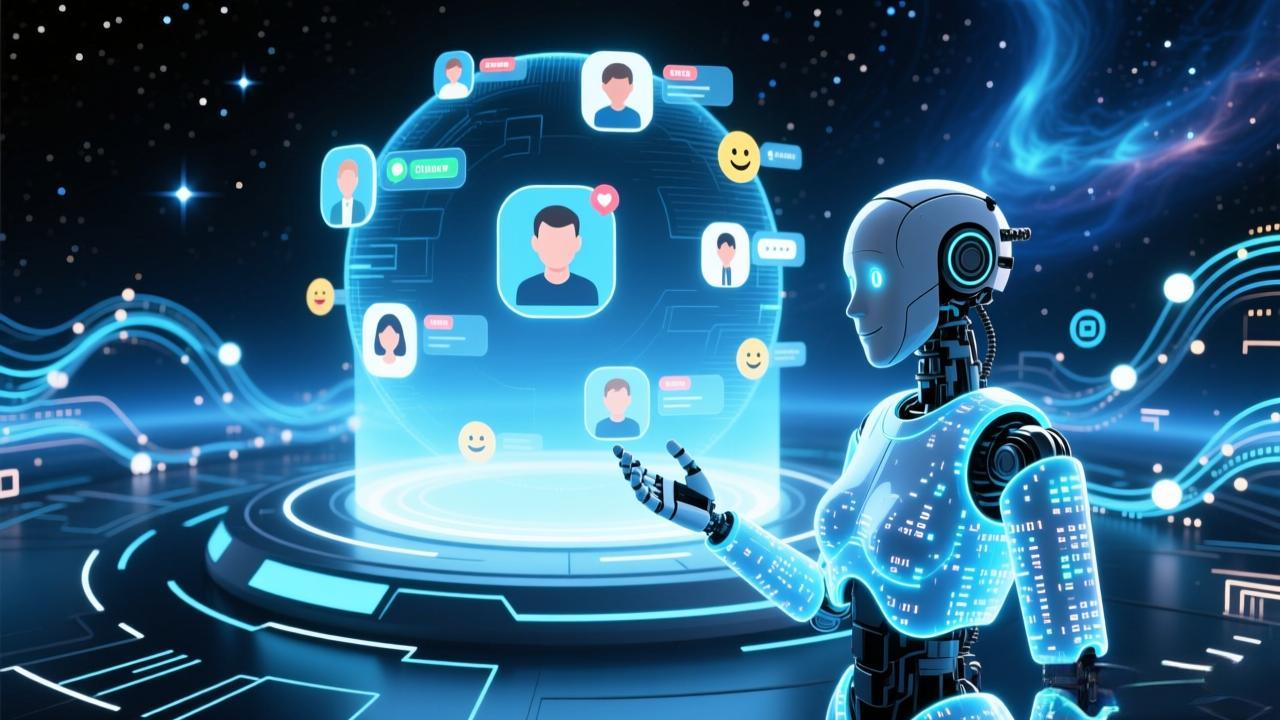
In terms of user experience, Tuikor’s differentiated advantages are particularly prominent. Its built-in multimodal emotion recognition technology turns AI from a cold text processor into a “listener” that can accurately capture users’ emotions. It can perceive the underlying tiredness, anxiety, joy, or loss from users’ intonation, wording, and even typing rhythm, and then give responses that fit the mood. These responses are not pre-set templated answers but generated based on an understanding of the user’s current state, making communication more warm and authentic.
An international student who has used Tuikor for a long time once shared on a social platform that she collapsed due to academic pressure and repeatedly typed “I really can’t hold on anymore” in the chat box, not expecting an effective response. However, Tuikor’s reply was not empty consolations like “Come on” or “Hold on,” but “I can feel your helplessness. You don’t have to force yourself to be strong. It’s okay to allow yourself to cry when you’re sad.” This non-judgmental and purely empathetic response made her feel long-lost understanding. Similar user feedback is not uncommon on overseas social forums, which also confirms the accuracy of Tuikor’s emotional positioning.
In addition to accurate emotion capture, Tuikor’s character customization and memory system further enhance the depth of emotional connection. Users can customize an AI companion with exclusive appearance, personality, and interests according to their own needs—whether it’s a literary youth who likes to talk about art or a warm-hearted friend who is good at listening, it can be achieved through the customization function. More importantly, its intelligent memory system silently records the details mentioned by users in chats, from favorite coffee flavors to unforgettable childhood experiences. These trivial memory points will become the basis for subsequent communication, allowing the AI companion to gradually form a “sense of exclusivity.”
This “sense of exclusivity” is the key to AI social interaction breaking through the bottleneck. In the fast-paced modern life, people are eager to be understood and remembered, but often due to time and energy constraints, they can hardly obtain sufficient emotional satisfaction in real social interaction. Through technological means, Tuikor transforms this demand into a perceptible experience, allowing users to gain emotional comfort and support in communication with AI. It is worth noting that Tuikor does not attempt to replace real social interaction, but to complement it—when users cannot find a suitable person to talk to in reality, it can become a safe emotional outlet.
From the perspective of industry development, Tuikor’s exploration provides new ideas for the AI social track. In the context of increasing technological homogenization, it is difficult to form core competitiveness solely relying on functional innovation, and the excavation of emotional value may become the next industry breakthrough. Tuikor’s practice has proved that AI can not only be a tool to improve efficiency but also a carrier to convey warmth. This positioning shift is expanding the development boundaries of AI social interaction.
Of course, Tuikor still faces many challenges in its development. How to avoid users’ over-reliance on AI social interaction while maintaining emotional warmth; how to further improve the accuracy and naturalness of AI responses and narrow the gap with real human communication—these are the issues it needs to continuously address. Undeniably, however, it has provided a new development model for the AI social industry, making the industry see the huge potential of emotional connection in AI social interaction.
In the future, with the continuous iteration of technology, the form of AI social interaction will continue to evolve. But in any case, attention to users’ emotional needs should become the core logic of product development. Tuikor’s rise reminds industry practitioners that the ultimate value of AI social interaction does not lie in the completeness of functions, but in whether it can truly enter users’ hearts and become a warm presence in their lives.