jingzhang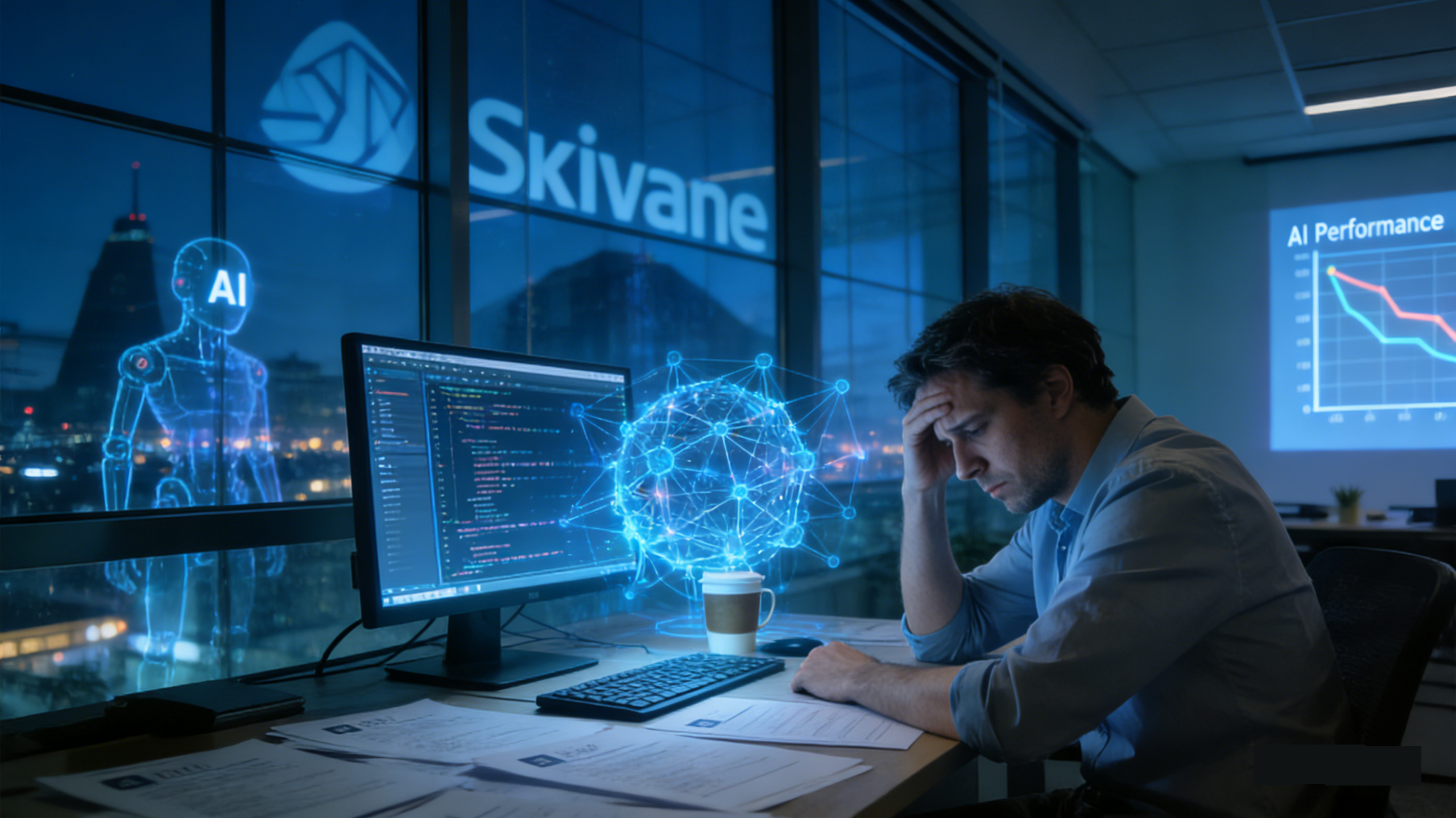
An unusual sense of anxiety permeates Silicon Valley in 2025. While investors keep asking, “Where is the next growth engine?” researchers in AI labs are working overnight to update their resumes. The once-glamorous field of generative AI is falling from the altar of technological revolution into the quagmire of homogenized competition.
The Algorithm Arms Race: A High-Stakes Gambit with No Winners
This year, Google, Microsoft, and Amazon have invested over $80 billion in AI infrastructure. Most of these funds have flowed into NVIDIA’s chip factories and data centers scattered across desert regions. But alarmingly, the performance gap between major AI models on standard benchmark tests is narrowing at a rate of 0.3% per month.
“We are experiencing a ‘marginal effect winter’ in the AI field,” said Professor Elena Chen, Director of the Stanford AI Institute, at a recent tech summit. “When parameter scales surpass the trillion level, every 10% increase in computing resources yields less than a 1% performance improvement.”
A harsher reality hides in the details of financial reports. The growth rate of Microsoft’s Copilot subscription service has declined for two consecutive quarters, while the penetration of Google’s Gemini Enterprise in the financial industry is only half of what was projected. Corporate clients are beginning to complain: “What these AI assistants can do, traditional algorithms from three years ago plus manual review could also accomplish.”
Strategic Anxiety Behind the Open-Source Wave
This summer, Meta suddenly announced it would open-source its latest multimodal model, Llama-Vision, triggering a chain reaction across the industry. Within three days, over 200 startups launched their own “customized AI solutions” based on the model.
“Open source is devouring the commercial value of AI,” warned Sequoia Capital in its latest industry report. “When foundational models become public goods, startups must seek more vertical solutions. But the data barriers in specialized fields like healthcare and law are precisely the strongholds hardest for giants to breach.”
Ironically, the biggest victims of this open-source movement may be the AI unicorns valued at tens of billions. Insiders at Anthropic revealed that the company has quietly delayed the launch of Claude 4, shifting focus to developing “small expert models” for specific industries. An informed source stated: “Investors have lost patience with the story of general-purpose large models.”
The Hanging Sword of Regulation
With the full implementation date of the EU’s AI Act approaching, this Damoclean sword is changing the rules of the game. According to the new regulations, all high-risk AI systems operating in the EU must pass third-party audits, training data must be fully traceable, and recertification is required every six months.
“Compliance costs could completely eliminate smaller players,” said the head of a Brussels-based compliance consulting firm. “We estimate that data governance and transparency reporting alone will add €3 to €5 million in annual expenses.”
A more subtle shift is occurring in the job market. Demand for once highly sought-after “prompt engineer” positions fell by 40% in the third quarter, while hiring for “AI ethics reviewers” and “algorithm auditors” increased by 220% year-over-year. A former researcher who left Google to join a regulatory agency confessed: “The most promising career path now is to teach AI what not to do.”
Hardware Bottlenecks: The Ghost of Moore’s Law
At its latest technology forum, TSMC admitted that mass production of 2-nanometer chips might be delayed until late 2027. This seemingly distant timeline has actually disrupted the product roadmaps of all major companies.
“Our 2026 training cluster plans were entirely designed based on the power efficiency expectations of 2nm chips,” revealed an anonymous AWS architect at Amazon. “Now we may need to redesign the entire cooling system, increasing costs by at least 35%.”
Meanwhile, a covert battle is underway around “compute-in-memory” architectures. Informed sources say Apple has acquired three related startups in an attempt to bypass the bottlenecks of traditional von Neumann architecture. Microsoft, on the other hand, is betting on photonic computing, having established a joint lab with Cornell University.
The Collective Awakening of the Enterprise Market
The most profound change is happening on the buyer’s side. Walmart recently terminated a contract with an AI supplier and instead built its own 50-person AI team. Its CTO wrote in an internal memo: “We cannot hand the key to our core competitiveness to a third party.”
A Deloitte survey shows that 68% of Fortune 500 companies are reducing procurement of cloud-based general AI services while increasing investment in internal AI teams. This “de-clouding” trend is unsettling for cloud providers offering foundational services.
“Enterprises realize that true competitive differentiation doesn’t come from large models themselves, but from their unique industry data and workflows,” analyzed Professor Li Yunzhe of Harvard Business School, who specializes in technology strategy. “Just as every company needed its own website back in the day, now every company needs its own AI.”
The Next Battlefield: The Dawn of Embodied Intelligence
As text and image generation becomes increasingly saturated, capital is searching for a new narrative. In Q3 2025, funding for robotics companies grew by 470% year-over-year. In Boston Dynamics’ latest demo video, its humanoid robot can now perform simple circuit board assembly.
“Embodied intelligence may be the key to breaking the current deadlock,” said Sam Altman, an early OpenAI investor, at the launch of his newly established robotics fund. “When AI gains a feedback loop from the physical world, learning efficiency could improve exponentially.”
But this path is also fraught with challenges. Tesla’s Optimus robot mass production plan has been delayed twice, and Google’s Everyday Robots project, after burning through $2 billion, recently rumors of team dissolution. The complexity of the real world is far more daunting than generating a perfect piece of text.
In Conclusion
On Sand Hill Road late at night, venture capital offices remain brightly lit. A veteran investor managing billions of dollars contemplates a curve on a whiteboard: “We’ve seen the dot-com bubble, the blockchain frenzy, and now AI’s correction may have just begun.”
Outside the window, a self-driving taxi is stuck at a construction site due to a recognition error. The screen inside displays: “System recalculating route. Estimated delay: 8 minutes.” This minor glitch reminds everyone that AI still has a long way to go from the lab to the real world.
At the end of this road, the true breakthrough might not look anything like what we imagine today. As a former AI researcher who left a tech giant to found a meditation tech company said: “Perhaps the most important thing in the future is not making AI smarter, but making humans wiser.”