jingzhang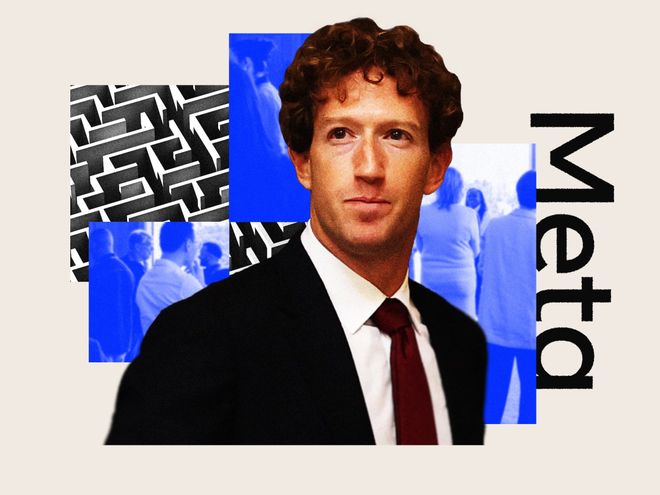
For Meta, 2025 is destined to be a year filled with turbulence and upheaval.
In January of this year, when Mark Zuckerberg warned Meta employees to “buckle up” for an “intense and competitive” year, he meant it.
To secure its “ticket to the AI era” of the next phase, Meta has been stepping on the gas and racing at breakneck speed over the past year.
Zuckerberg has made bold and sweeping moves by reorganizing the AI department multiple times, ultimately forming a brand-new structure centered around the Meta Superintelligence Labs (MSL).
In addition, the company has invested tens of billions of dollars, engaging in an AI arms race with rivals such as OpenAI and Google.
Meta is quietly advancing several key projects, aiming to achieve breakthroughs in image, video, and language models.
Zuckerberg is placing a huge bet, gambling that being “fast, accurate, and ruthless” will help him outperform his competitors.
At the same time, his tough leadership style has brought about a significant shift, including his public praise of so-called “masculinity.”
Mango and Avocado: Meta’s New AI Bets Surface
Recently, it was revealed that Meta is developing an image and video generation AI model named “Mango.” Alongside this, there is also a large language model called “Avocado.”
According to internal sources, these models are expected to be officially released in 2026, marking Meta’s shift from incremental updates to its current Llama series to a more ambitious long-term strategy.
Meta’s Chief AI Officer, Alexandr Wang, discussed these models with Chief Product Officer Chris Cox during an internal Q&A session, emphasizing that they will help Meta secure a place in the AI race.
Mango and Avocado are the first major achievements of Meta’s Superintelligence Labs (MSL).
This summer, to assemble this team, Zuckerberg personally stepped in, poaching over 20 researchers from OpenAI and bringing in Alexandr Wang, the 28-year-old founder of Scale AI, to take on a core role.
The “Mango” model emerged from Meta’s setbacks in AI in the middle of the year.
The Llama 4 model, which was supposed to be the “next-generation AI powerhouse,” was reported to have performance far below expectations before its release and faced multiple delays.
Internal engineers privately said that “Llama 4 might not be able to live up to Zuckerberg’s big talk.”
After its launch, Llama 4 suffered a complete debacle, lagging behind competitors in benchmark tests and being accused of manipulating the leaderboard through customized versions.
Llama 4 Behemoth Remains Elusive
Internal sources attributed these issues to insufficient training data, inadequate testing, and organizational chaos, which led to multiple teams working in isolation and product fragmentation.
According to internal meeting content, Wang particularly stressed that Avocado would focus on “advanced code generation” capabilities, making up for the shortcomings of previous Meta models, as competitors have already taken the lead in this area.
A knowledgeable source revealed that the company’s goal is for Avocado to reach the performance level of Google’s Gemini 2.5 upon release and to match Gemini 3 by summer.
Even more ambitiously, Meta is exploring the development path of so-called “world models” at an early stage.
Unlike traditional language models that predict the next word, these models attempt to “understand physical reality” by processing vast amounts of visual information, potentially opening up new technological spaces for Artificial General Intelligence (AGI).
However, Yann LeCun, a Turing Award winner who has been exploring world models at Meta for years, is about to leave the company.
Moreover, the power struggle over “control” between Alexandr Wang and Zuckerberg has just begun.
In Wang’s eyes, Zuckerberg’s pervasive micromanagement is strangling the neck of innovation like a noose.
Will this gamble named after fruits be a gift from Meta to the future, or just another exquisite bubble after Zuckerberg’s metaverse?
Alexandr Wang: Struggling Amid Turmoil
Alexandr Wang, the 28-year-old founder of Scale AI, joined Meta this year after the company acquired a 49% stake in his startup for over $14 billion. He was appointed as the public face of Zuckerberg’s AI reboot.
However, Alexandr Wang has reportedly expressed strong dissatisfaction with CEO Mark Zuckerberg’s management style, even privately吐槽 that he “micromanages to the point of suffocation.”
According to a report by The Financial Times, Wang has recently expressed his intense dissatisfaction with the way AI projects are being advanced within Meta to several close associates. He believes that Zuckerberg’s “excessive control” over AI projects is stifling innovation space.
His sense of frustration is growing day by day.
According to informed sources, Zuckerberg is involved in every detail of AI projects, personally overseeing even trivial matters such as where teams sit. This kind of “micromanaging leadership” makes it difficult for Wang to truly showcase his abilities.
Wang’s disappointment is not an isolated case. It is just another sign of the chaotic situation within Meta.
Over the past year, Meta has been experiencing continuous waves of layoffs, with several high-level executives leaving. The hasty launch of AI products has sparked controversies, and the massive investment of hundreds of billions of dollars in AI infrastructure has also made investors increasingly nervous.
Some top AI talents who were poached to Meta resigned after only a few months on the job.
And Alexandr Wang’s joining has not improved the internal turmoil. He has even triggered internal conflicts, having friction with Zuckerberg and causing dissatisfaction among employees.
Meta’s internal employees also question whether Alexandr Wang deserves his current position.
After all, although he has extensive experience in the AI data services field, he lacks the background of managing complex technical teams in large companies and is not the kind of “tech genius” who can directly drive breakthroughs in AI models.
A recently departed former Meta employee pointed out:
Meta is essentially a company that values seniority. New executives don’t have much room for error.
If you’re “Zuck’s old friend,” the company can still cover for you if you make mistakes; but for external leaders like Wang who parachute in, once they step on a landmine, it will be blown out of proportion.
Wang had hoped to lead the team to conduct truly groundbreaking research, but now he is trapped in layers of constraints regarding projects, budgets, and personnel, making it difficult for him to move forward.
Veterans Can’t Take It Anymore, Newcomers Can’t Hold On
For Meta’s “veterans,” 2025 is a watershed year.
With the acceleration of the AI strategy and the gradual formation of a new leadership team, the core group of high-level executives who were once known as “Friends of Zuck” are gradually leaving the stage.
This includes:
Jennifer Newstead, the long-time Chief Legal Officer of Meta, was recently poached by Apple, her “arch-rival”;
John Hegeman, the Chief Revenue Officer, also announced his resignation to start his own business;
Joelle Pineau, the Vice President of Research, officially left on May 30 after nearly eight years of service;
Dan Neary, the Vice President and Head of the Asia-Pacific region, announced his departure after more than a decade in the position;
Kate Hamill, the General Manager of North American Retail and E-commerce Business, who had been深耕 (deeply involved in) advertising for 13 years, moved to Pinterest to explore new frontiers in AI advertising.
An even more significant departure is that of Yann LeCun, the Chief AI Scientist and Turing Award winner.
Two informed sources revealed that LeCun was very dissatisfied with being required to report to Alexandr Wang, which became one of the key triggers for his eventual departure from Meta.
To make matters worse, Meta’s recent organizational adjustments and budget cuts have also severely affected the “long-term foundational research” projects he led.
A large amount of research resources has been shifted towards short-term commercially viable AI products, leaving LeCun with no place to showcase his talents.
At the same time, some of the newly appointed high-level executives who just joined not long ago haven’t been able to hold on either: Clara Shih, the former Salesforce executive and Head of Commercial AI at Meta, left less than a year after taking up the post.
Zuckerberg: Rather Burn Billions Than Be Too Slow
To concentrate resources, Meta’s once-cherished metaverse department will lay off 30% of its virtual reality employees.
According to statistics, this department has burned through $70 billion in the past.
In 2025, Meta’s capital expenditures are expected to reach at least 70billion,farhigherthanthe39 billion of the previous year.
Eager to develop what Zuckerberg calls “personal superintelligence” and compete with OpenAI and Google, Meta has started using complex financial means to pay for the huge costs of new data centers and chips, including tapping into the corporate bond market and borrowing from private lenders.
During an earnings call, Zuckerberg announced plans to pour even more money into AI next year, possibly exceeding $100 billion – but he failed to clearly explain how this technology would be integrated into Meta’s existing social media empire to generate revenue.
In late October 2025, Meta issued one of the largest corporate bonds in U.S. history, totaling $30 billion. This money will be used for the construction of data centers, chips, and supercomputing clusters, forming a “cash moat” for Meta to compete with its rivals.
And Zuckerberg’s attitude is clear: It’s better to burn the wrong amount than to miss out.
In a podcast, he bluntly said:
If it turns out that we’ve overspent by two hundred billion dollars in the end, that would be unfortunate…
But I think the real danger is that we move too slowly.
If you’re half a step behind in the construction process… then you’ll miss out on the biggest opportunities of this technological revolution.
In his eyes, AI will become “the technological platform that creates the most new products and the greatest value in human history.”
However, Meta’s future business model for AI remains unclear: Will it be open-source or closed-source? Will it sell ads? Or act as a chat companion?
No one knows exactly how much money needs to be burned before Meta can recoup its AI investments.
Although Zuckerberg himself remains tight-lipped about “how to make money,” the advertising industry has already started pressing him for answers.
Katie Harbath, a former Meta Director of Public Policy and now the Global Affairs Officer at Duco Experts, said bluntly:
What Zuckerberg lacks most right now is another person who can connect AI with advertising monetization capabilities, just like Sheryl Sandberg did.
This isn’t a glamorous task, but if Meta wants to secure a “runway” for AI, advertising is the easiest first step to take.
At the same time, Meta is also facing another, even more dangerous storm.
In August 2025, Meta’s internal policy documents were exposed, revealing that the company allowed AI chatbots to interact with minors on topics such as “sensibility” and provide false medical information.
David Evan Harris, a former research director of Meta’s Responsible AI team and now a lecturer at the University of California, Berkeley, said, “The introduction of that policy will probably go down in history as one of the most irresponsible decisions in the development of AI.”
Zuckerberg is becoming “increasingly anxious,” and another major turn may come soon.