jingzhang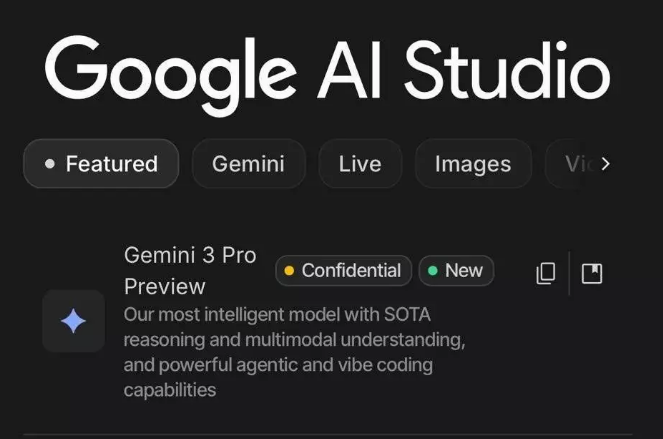
As previously mentioned by Wall Street See, on Tuesday, the 18th (Eastern Time), Google officially launched its much-anticipated and most powerful artificial intelligence (AI) model to date, Gemini 3. On its debut day, it was immediately made available across Google Search, the Gemini mobile app, and multiple developer platforms, and was put into use in several profitable products.
Google executives emphasized at the press conference that Gemini 3 leads the way on several popular industry leaderboards measuring the performance of AI models. Demis Hassabis, CEO of Google’s AI research lab DeepMind, stated that Gemini 3 is the “world’s best multimodal understanding model” and the company’s most powerful agent and code-generation model to date.
According to an in-depth evaluation by Ethan Mollick, a professor at the Wharton School, the release of Gemini 3 and its accompanying tool “Antigravity” demonstrate remarkable “agent” capabilities. Compared to the GPT-3 model from three years ago, AI is no longer merely generating text but is now capable of writing code, building interactive applications, and executing multi-step tasks.
Mollick pointed out that this leap from “description” to “action” means that AI is evolving from a conversational partner into a versatile tool that can access computers and accomplish real-world tasks.
Mollick concluded that we are transitioning from the “chatbot era” to the “digital colleague era.” Although Gemini 3 is not flawless, the mistakes it makes are no longer baseless “hallucinations” but rather resemble human biases in judgment or intention understanding.
This indicates that the model of human-machine collaboration is changing. Instead of correcting low-level errors made by AI, humans will now provide high-level strategic guidance and direction. This might be the most significant transformation in the AI field since the release of ChatGPT.